
Table of Contents
Estimating the number of bricks required for a wall is an important part of construction planning. Buying too few bricks can delay a project, while buying too many increases material waste and cost.
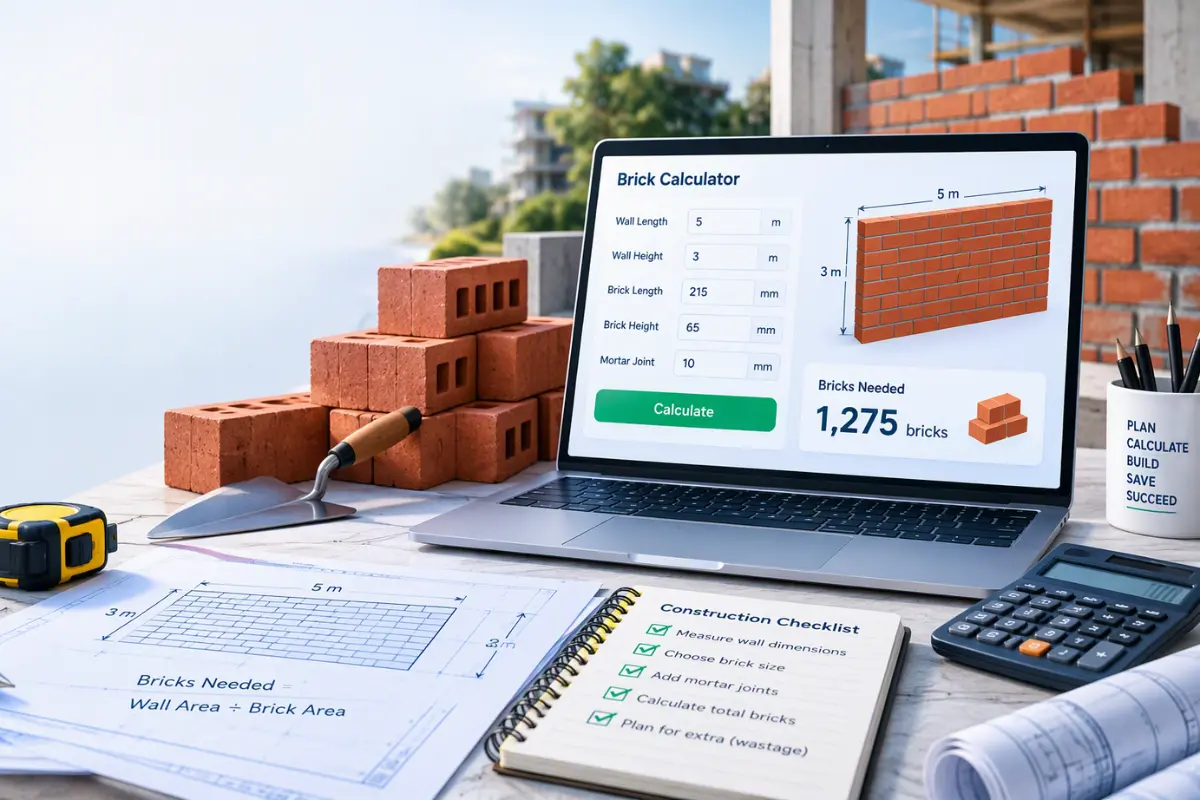
A brick calculator makes this process much easier by using the wall dimensions, brick dimensions, mortar joints, and an appropriate waste allowance. Whether you are building a garden wall, house extension, partition wall, or other masonry structure, accurate brick quantity calculation can help you plan materials and costs more effectively.
In this guide, we explain how to calculate bricks needed for a wall and how to use a brick quantity estimator for faster results.
What Is a Brick Calculator?
A brick calculator is a construction tool used to estimate the number of bricks required for a wall or masonry project.
A typical calculator considers:
- Wall length
- Wall height
- Wall thickness
- Brick length
- Brick height
- Mortar joint thickness
- Openings such as doors and windows
- Percentage of material waste
The result provides an estimated number of bricks required for the project.
A brick calculator can be considered a type of construction material calculator, masonry calculator, or wall construction calculator.
Why Accurate Brick Quantity Calculation Matters
Accurate brickwork estimation helps you control both materials and costs.
An accurate estimate can help you:
- Determine how many bricks to order
- Reduce material waste
- Estimate masonry costs
- Plan transportation
- Prepare a construction budget
- Compare supplier prices
- Avoid project delays
For larger projects, even a small difference in the estimated number of bricks can significantly affect the total construction cost.
How to Calculate Bricks Needed for a Wall
The basic calculation starts with the total wall area.
Step 1: Calculate the Wall Area
Use the following formula:
Wall Area = Wall Length × Wall Height
For example, suppose a wall is:
- Length = 10 m
- Height = 2.5 m
The wall area is:
10 × 2.5 = 25 m²
So, the wall has a total area of 25 square meters.
Step 2: Calculate the Brick Face Area
Next, determine the area covered by one brick.
For example, assume the brick dimensions are:
- Length = 200 mm
- Height = 100 mm
Convert the dimensions to meters:
- 200 mm = 0.20 m
- 100 mm = 0.10 m
Brick face area:
0.20 × 0.10 = 0.02 m²
Without considering mortar joints, one brick covers approximately 0.02 m².
Step 3: Include the Mortar Joint
Bricks are normally installed with mortar joints between them. Therefore, the calculation should consider the brick dimensions plus the mortar joint.
For example, with a 10 mm mortar joint:
Effective brick length = 200 + 10 = 210 mm
Effective brick height = 100 + 10 = 110 mm
Convert to meters:
0.21 × 0.11 = 0.0231 m²
The approximate number of bricks per square meter is therefore:
1 ÷ 0.0231 ≈ 43.3 bricks/m²
This value will vary depending on the actual brick size and mortar joint thickness.
Step 4: Calculate the Total Number of Bricks
Now multiply the wall area by the estimated bricks per square meter.
Using our example:
25 × 43.3 = 1,082.5 bricks
Since you cannot purchase half a brick, round the result up:
1,083 bricks
This is the estimated quantity before adding waste.
Step 5: Add a Waste Allowance
Some bricks may be broken, damaged, incorrectly cut, or lost during transportation and construction.
A common approach is to add approximately 5% to 10% for waste, depending on the project.
For a 5% allowance:
1,083 × 1.05 = 1,137 bricks
You would therefore order approximately 1,137 bricks.
For projects with more cutting, transportation, or handling, a higher allowance may be appropriate.
How to Account for Doors and Windows
Wall openings reduce the amount of brickwork required.
Suppose the 25 m² wall contains a door measuring:
- Width = 1 m
- Height = 2 m
Door area:
1 × 2 = 2 m²
Net wall area:
25 − 2 = 23 m²
Instead of calculating bricks for 25 m², you should calculate them for 23 m².
This produces a more accurate brick quantity calculation.
The same method can be applied to windows and other openings.
Brick Calculator Formula
A simplified brick estimation formula is:
Bricks Required = Net Wall Area ÷ Effective Brick Area
Where:
Net Wall Area = Total Wall Area − Opening Area
And:
Effective Brick Area = (Brick Length + Mortar Joint) × (Brick Height + Mortar Joint)
After calculating the basic quantity, add your selected waste percentage.
Final Formula
Bricks Required = (Net Wall Area ÷ Effective Brick Area) × (1 + Waste %)
This formula provides a useful starting point for brickwork estimation.
Factors That Affect Brick Quantity
Several factors can change the final number of bricks required.
Brick Size
Brick sizes vary by country, manufacturer, and construction system. A larger brick generally covers more wall area and therefore requires fewer units.
Always use the actual dimensions of the bricks you plan to purchase.
Mortar Joint Thickness
Mortar joints occupy space between bricks. A thicker joint can reduce the number of bricks required per square meter.
However, the appropriate joint thickness should follow the construction specifications for the project.
Wall Thickness
A standard single-brick wall and a thicker masonry wall require different quantities of bricks.
For thicker walls, the calculation may need to account for the number of brick layers or the wall’s construction pattern.
Openings
Doors, windows, vents, and other openings reduce the total masonry area.
Accurately measuring these openings improves the estimate.
Waste
Construction projects rarely use exactly 100% of purchased materials. Including a reasonable waste allowance helps avoid shortages.
Using a Brick Quantity Estimator
A brick quantity estimator can simplify all of these calculations.
Instead of calculating each value manually, you can enter:
- Wall length
- Wall height
- Brick length
- Brick height
- Mortar joint
- Door and window areas
- Waste percentage
The calculator can then estimate the required brick quantity.
This makes a wall brick calculator particularly useful when estimating several walls or comparing different brick sizes.
Estimating Brick Cost
Once you know the required quantity, estimating the material cost is straightforward.
Use:
Brick Cost = Number of Bricks × Price per Brick
For example, if you need 1,137 bricks and each brick costs $0.50:
1,137 × $0.50 = $568.50
You can then include mortar, sand, labor, transportation, and other expenses to develop a broader construction cost estimation.
A brick cost calculator can make this process faster by combining quantity and unit price.
Brick Calculator vs. Manual Calculation
Manual calculations are useful for understanding the estimation process, but a calculator can save time and reduce arithmetic errors.
A masonry calculator is especially useful when:
- You have multiple walls
- Walls contain several openings
- You need to compare brick sizes
- You want to include waste automatically
- You need a quick material estimate
- You are preparing a construction budget
For larger projects, however, calculator results should be treated as estimates and checked against the project’s construction drawings and specifications.